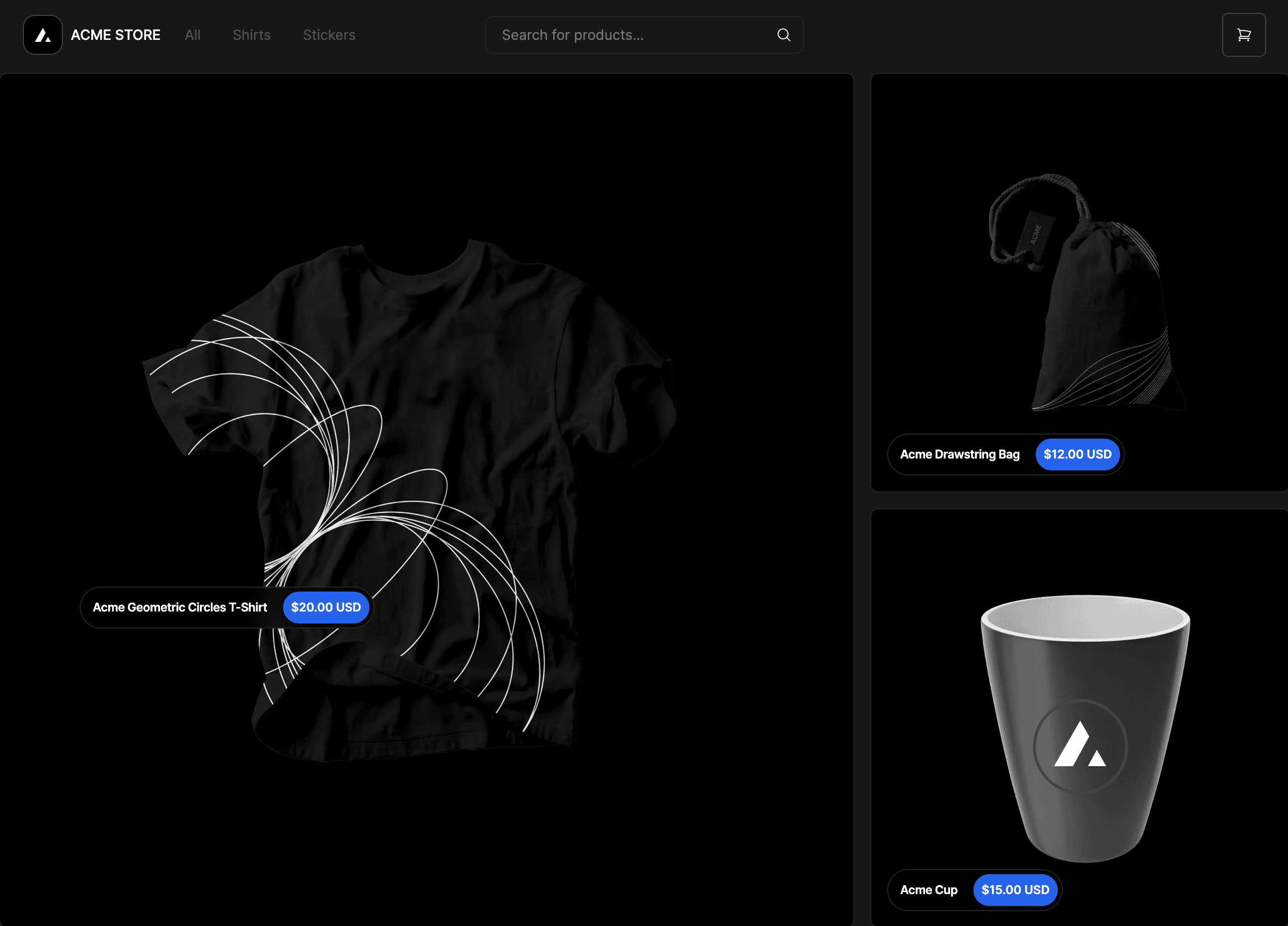
Paper
A minimal, production-ready storefront template for Saleor.
Clean as a blank page — built to ship with agents and humans.
[!TIP] Questions or issues? Check our Discord for help.
Why Paper?
Ship faster, customize everything. Paper is a new release—expect some rough edges—but every component is built with real-world e-commerce in mind. This is a foundation you can actually build on.
🛒 Open Checkout (v2)
The checkout is where most storefronts fall apart or fall short. Paper's doesn't — and checkout v2 aligns it with the rest of the stack: App Router, Server Components, server actions, and the same BFF session as the storefront (no client-side urql or browser Saleor tokens).
- Server-first cart — RSC loads checkout +
meon entry; client context is a cache of server truth (CheckoutDataProvider). - URL-driven steps —
?step=contact|shipping|paymentupdates shallowly (no full page refetch per click); browser Back walks the funnel. - Dedicated confirmation —
/checkout/complete?order=is separate from the active cart route. - Extensible payments — Registry (
INTEGRATED_GATEWAYS) with Stripe + Dummy; add gateways viacheckout-payment-gatewaysskill. - Shared BFF auth — Sign-in via
/api/auth/login; session resolved server-side (resolveSessionUser— guest / authenticated / unavailable). - Multi-step, mobile-first — Focused forms, international address fields, composable step components.
Developer docs: start at skills/saleor-paper-storefront/rules/paper-surfaces.md [blocked], then checkout-management.md [blocked]. Forks on the old urql checkout: migrations/atomic/2026-06-checkout-v2/ [blocked].
🌍 Multi-Channel, Multi-Currency
One codebase, many storefronts. Channel-scoped routing means /us/products and /eu/products can serve different catalogs, prices, and shipping options—all from the same deployment.
Storefront channels are explicit. Saleor may have many channels (B2B, wholesale, internal regions); Paper only exposes the slugs you configure via STOREFRONT_CHANNELS. Disallowed channel URLs return 404. For a single-channel store, set NEXT_PUBLIC_DEFAULT_CHANNEL only—the footer channel selector is hidden automatically.
📱 Product Pages Done Right
The hard parts are solved. Adapt the look, keep the logic.
- Partial Prerendering (PPR) — Product name, attributes, and SEO stay in a static cached shell; variant gallery and add-to-cart stream in via Suspense when
searchParamschange. - Multi-attribute variant selection — Color + Size + Material? Handled. Complex variant matrices just work.
- Dynamic pricing — Sale prices, variant-specific pricing, channel pricing—all reactive.
- Image gallery — Next.js Image optimization, proper aspect ratios, keyboard navigation.
♿ Accessibility Built In
Not an afterthought. Focus management on step transitions, keyboard navigation everywhere, semantic HTML, proper ARIA labels. Everyone deserves to shop.
🤖 AI-Ready Codebase
Built for front-end developers and AI agents. The codebase includes:
AGENTS.md— Architecture overview and quick reference for AI assistantsskills/saleor-paper-storefront/[blocked] — 14 task-specific rules covering GraphQL, caching, variant selection, checkout v2, and more- saleor/agent-skills — Universal Saleor API patterns; install additional skills (React best practices, composition patterns) via
npx skills add - Consistent patterns — Predictable structure that AI tools can navigate and modify confidently
Whether you're pair-programming with Cursor, Claude, or Copilot—the codebase is designed to help them help you.
⚡ Bleeding Edge Stack
- Next.js 16 with App Router and Server Components
- React 19 with the latest concurrent features
- TypeScript in strict mode—your IDE will thank you
- Tailwind CSS with design tokens (OKLCH colors, CSS variables)
- GraphQL Codegen for type-safe Saleor API calls
What's in the Box
| Feature | Description |
|---|---|
| Checkout (v2) | RSC + server actions, shallow step URLs, payment registry (Stripe/Dummy), /checkout/complete |
| Cart | Slide-over drawer with real-time updates, quantity editing |
| Product Pages | Multi-attribute variants, image gallery, sticky add-to-cart |
| Product Listings | Category & collection pages with PPR (cached hero + dynamic filters), pagination |
| Navigation | Dynamic menus from Saleor, mobile hamburger |
| SEO | Metadata, JSON-LD, Open Graph images |
| Caching | Cache Components (PPR), named cacheLife tiers, channel-scoped tags, webhooks |
| Saleor Cloud Paper app | Saleor Cloud only — Dashboard extension for cache invalidation webhooks and Preview in storefront |
| Customer Profile | Account dashboard, address book, order history, password change, account deletion |
| Authentication | Login, register, password reset, guest checkout |
| API Resilience | Automatic retries, rate limiting, timeouts—handles flaky connections gracefully |
Caching Architecture
Paper uses Cache Components (Partial Prerendering) for optimal performance—static shells load instantly while dynamic content streams in. Learn more in the Next.js documentation or see skills/saleor-paper-storefront/rules/data-caching.md [blocked] for project-specific implementation details.
The display-cached, checkout-live model ensures fast browsing with accurate checkout:
How It Works
| Component | Freshness | Why |
|---|---|---|
| Product pages | Cached (catalog) | Static shell + dynamic variant islands (PPR) |
| Category/Collection | Cached (catalog) | Cached hero from params; filters/pagination stream in Suspense |
| Homepage featured | Cached (catalog) | Sync page shell; product grid streams in nested Suspense |
| Navigation / footer | Cached (menus) | Per-channel tags: navigation:{channel}, footer-menu:{channel} |
| Cart drawer | Always live | Saleor API with cache: "no-cache" |
| Checkout | Always live | RSC entry + server actions (cache: "no-cache"), real-time totals |
cacheLife tiers (see src/lib/cache-life-profiles.ts):
| Profile | Fallback TTL | Used for |
|---|---|---|
catalog | ~5 min | Products, categories, collections, homepage |
menus | ~1 hr | Header nav, footer menu |
channels | ~1 day | Footer channel metadata |
Webhook revalidateTag(tag, profile) clears data immediately; TTL is the safety net when webhooks are missing.
PPR page patterns
Cached GraphQL lives in src/lib/catalog/, src/lib/menus/, and src/lib/channels/ — not in layout or page components. Pages are thin orchestrators with nested <Suspense> for dynamic islands.
PDP — params only in the static shell; gallery and variant selection read searchParams:
PLP (category, collection, all products) — cached hero/metadata from params; filter/sort/pagination in a dynamic grid:
Homepage — sync <section> shell; featured collection grid in nested Suspense.
Loading UX — route-level loading.tsx files (products, categories, collections) show skeletons during navigation. The main layout does not wrap {children} in Suspense fallback={null}.
Cache tags (see src/lib/cache-manifest.ts):
| Tag pattern | Invalidated when |
|---|---|
product:{slug} | Product updated |
category:{slug} | Category updated |
collection:{slug} | Collection updated |
navigation:{channel} | Main menu changed for channel |
footer-menu:{channel} | Footer menu changed for channel |
channels | Channel list metadata |
Featured homepage products use tag collection:featured-products (same catalog profile as collections).
Instant Updates with Webhooks
Saleor Cloud (recommended): Install the Saleor Cloud Paper app from Dashboard → Extensions. Available on Saleor Cloud only for now. It registers revalidation webhooks for products, categories, collections, pages, menus, and promotions; discovers cache tags via /api/cache-info; and adds Preview in storefront on product pages in Dashboard.
Self-hosted / manual setup:
- Create webhooks in Saleor Dashboard → Configuration → Webhooks
- Point to
https://your-store.com/api/revalidate - Subscribe to product/category/collection/page events; for menus use
MENU_*/MENU_ITEM_*and include{ menu: { slug } }fornavbarandfootermenus - Set
SALEOR_WEBHOOK_SECRETenv var
Manual revalidation (requires REVALIDATE_SECRET):
Without webhooks? TTL handles it—cached data expires per the catalog / menus / channels profiles above.
Why This Is Safe
- Saleor is the source of truth:
checkoutLinesAddcalculates prices server-side - Cart always fetches fresh: Users see current prices before checkout
- Payment validates:
checkoutCompleteuses real-time data
📚 Deep dive: See
skills/saleor-paper-storefront/rules/data-caching.md[blocked] for the full architecture, Cache Components (PPR), webhook setup, and debugging guide.
Quick Start
[!NOTE] New to Saleor? Check out saleor.io/start to learn how storefronts work underneath.
1. Get a Saleor Backend
Option A: Free Saleor Cloud account (recommended)
Option B: Run locally with Docker
2. Clone & Configure
Edit .env with your Saleor instance details:
Multi-channel (recommended — explicit allowlist):
Finding your channel slug: In Saleor Dashboard → Configuration → Channels → copy the slug
Note:
SALEOR_APP_TOKENalone no longer auto-discovers every Saleor channel. SetSTOREFRONT_CHANNELSor opt in withSTOREFRONT_DISCOVER_CHANNELS=true(see Environment Variables).
3. Run
Open localhost:3000. That's it.
Development
Commands
Project Structure
For AI Agents
If you're working with AI coding assistants, point them to:
AGENTS.md— Architecture, commands, gotchasskills/saleor-paper-storefront/— 13 project-specific rules (GraphQL, caching, checkout, etc.)- saleor/agent-skills — Universal Saleor patterns and optional community skills (React best practices, composition patterns, etc.)
To install skills for agent auto-discovery:
Environment Variables
Channel resolution order (getStorefrontChannelSlugs):
STOREFRONT_CHANNELS— explicit allowlist (recommended)STOREFRONT_DISCOVER_CHANNELS=true+SALEOR_APP_TOKEN— all active channels from APINEXT_PUBLIC_DEFAULT_CHANNELonly — single-channel storefront
Payments
The checkout architecture supports Saleor payment apps like Adyen and Stripe. The heavy lifting is done—integrating your gateway requires minimal work compared to building from scratch.
Customization
Paper works as a reference implementation and as a starting point for your own storefront. Start here:
- Colors & typography →
src/styles/brand.css - Components →
src/ui/components/ - Checkout flow →
src/checkout/views/SaleorCheckout/
The design token system uses CSS custom properties—swap the entire color palette by editing a few lines.
Next Steps
Features planned for future development:
- Filtering logic iteration. Fetching attributes from API for dynamic product filters.
- Opinionated model for standard content. Moving currently hardcoded stuff like Credibility or Free checkout information to API models.
License
FSL-1.1-ALv2 (Functional Source License, Version 1.1, ALv2 Future License) — use it, modify it, ship it. Build your storefront, run your business. The license converts to Apache 2.0 after two years.
Want to offer it as a managed service? Let's talk.
Built with 🖤 by the Saleor team